Game Design, Programming and running a one-man games business…

Conjured enthusiasm

I’m a bit of a fan of Neuro Linguistic Programming. One of the ideas within NLP is you can effectively ‘reverse’ the way behavior and emotions work. Generally, you think that if you are sad, you look sad, you slouch, you look down, you speak low and slowly, your face has certain expressions, etc.

NLP suggests you can reverse that process. You can effectively ‘act’ happy / enthusiastic / confident and so on, and by adopting the posture / voice, actions of someone who feels that way, you actually *do* feel like that, genuinely as a result. I am 100% convinced this can work. I’ve used in hundreds of times, probably thousands. I can assert to the world that I am motivated and energized, and magically it works. If you get the hang of it, it’s an amazing technique.

It’s also something you really need when you start work on a new game, which is what I’ve been doing lately. It’s very easy to look at a few blobs on a screen, with missing text, missing functionality and tell yourself that this game will suck, and you should abandon it. It really doesn’t help if your last game looked nice and shiny, and I think mine did :D.

Apart from weird freaky new-age NLP nonsense, I also find that explaining the game to someone else works wonders. I strongly recommend drawing a diagram on a big chalkboard in your office, and waving your arms about a lot whilst pointing at squiggles and saying how awesome it will be.

The plan is to keep that sort of thing going until you have enough of a game to *really* know if it is going to work or not. My usual strike rate is one in three, meaning there is a 66% chance o me dumping this idea for another one before it goes into full production with artwork etc. I do have an especially good feeling about this one though.

Sense of progression

Increasingly I find myself drawn to games that have a sense of progression, a feeling of permanence, or some other ‘value’ beyond the immediate sensation of fun. I guess I’m a pretty ambitious, and long-term thinking person, so that naturally spills out into my gaming habits. I want my gaming time to be an investment.

Generally, my games have failed in this area. The very name of GSB suggests that it is pointless, a one-off bit of fun, to be enjoyed purely for the spectacle and the giggles. There is a high score table for the survival mode, but there are no achievements. There are unlockable items, but not a huge proportion of the options are locked. The game is more like a chest full of toys, than it is a linear, scripted and proscribed ladder.

Obviously there are gamers who prefer that. You’ve probably seen Dara O Brian lamenting the fact that he buys a game, but isn’t allowed to play it?

However, although I have some sympathy with that view, I also think that the worst cases of it can be worked around. I always remember my frustration in the D-Day landings part of Medal of Honor. After 15 deaths, I thought “Why the hell doesn’t the game kick in a script where a nearby soldier drags me to safety at this point? We all know I failed metaphorically here, so let me continue with the fun.”

The design of my next game is very much in flux, it’s more like GSB than any other of my other games, but it is not a straight GSB sequel or spin-off. It might be, in some ways, a bit simpler, but it will also have a lot more possibilities in others. It will have more of a feeling of progression than GSB did, and I am pretty sure it will be all the better for it.

Show Me The Space-sim!

Theres a new interview over at my little side-project site ShowMeTheGames today:

http://www.showmethegames.com/starwraith_interview.php

it’s an interview with the guy who makes a very nice looking space sim that reminded me of freespace and Elite. Like me, he is a workaholic one man indie maniac. Check it out.

Today has been non-GSB work, for the most part. It seems like patches 1.51 and 1.52 didn’t end the world, which is nice. Recently there was a cool review of GSB over at eurogamer, feel free to comment on it if you have an account:

http://www.eurogamer.net/articles/2010-12-09-gratuitous-space-battles-review

Today was spent partly buying food from the market (one of the best things about working from home is you can go shopping when everyone else is at work), and partly doing the SMTG interview, plus also some basic work on mystery game IV. That involved taking some existing code from GSB and pulling it apart for the bits I wanted. It also allowed me to do a serious re-write of some of it, which it badly needed.

It’s amazing how a supposedly simple class in C++ can grow and grow and grow until you swear to yourself to make it more modular next time around…

Copyright and getting some perspective

Oh noes, a post about copyright! batten down the hatches etc…

The copyright debate is in deadlock, as ever, and the two sides are way too far apart.

There are maniacs out there that think you shouldnt be able to sing copyrighted songs at a birthday party. There are maniacs out there that think if you upload a youtube video of a child singing a pop song, it should be taken down. There are maniacs out there who think they can copyright generic terms and words that have been in use for decades or centuries and prevent others using them. There are people who think that the word ‘orange’ or ‘apple’ now belong to companies. Fuck that. There are people who think they can patent clicking a mouse, and even one batshit mental woman who thinks she owns the sun.

And all of these people should be thrown into a pit of tigers and then attacked with flamethrowers.

But…

Often the anti-copyright or ‘copyright reform’ side of the argument does itself no favours. Like many angry internet movements, they get so entwined with complete headcases who want to repeal copyright as an idea, that their whole argument becomes tainted.

Check out this game:

The guy making it got a DMCA takedown request from the owners of the Pacman IP. OH MY GOD! IT’S FASCISM AT WORK! Or maybe not… maybe he just ripped off pacman 100%, didn’t even have the creative juices to pick new colors for the ghosts, and he thinks *he* is the victim?

Now I know Namco don’t need the money, but the principle remains the same. The same copyright law that protects billionaires also protects indie developers like me, and everyone in between. And don’t forget, if you are IT literate and creative, the chances that your livelihood will directly or indirectly be earned from copyright are extremely high these days.

People rightfully get annoyed at some of the crazy DRM schemes and evil bastards that push copyright beyond its sensible uses, but people need to also get rightfully annoyed at the people who make any calls to reform copyright laughable. When people rip off a game, a movie, a tv show, a book or anything else to the point where you can’t tell the difference, the copyright reformers need to call them out on it. The same goes for certain torrent sites, and the ‘anonymous download’ servcies that are 99% copyrighted content.  Getting bundled in with people trying this stuff just makes the whole copyright-reform lobby look like trolls.

TV, and the public face of gaming

So there is a BBC TV prog on ‘addiction in gaming’ on the way. Oh JOY. Not that I do not think there is a case to answer, there definitely is. Games ARE designed to be addictive, just ask Zynga, or ask pretty much any game designer who has read widely both on game design, and neuroscience. (like me!). The problem is that traditionally, the mainstream media has handled issues in gaming so incredibly poorly, in such a slap-dash ‘who cares’ fashion, as to make any ‘research’ into the topic on  popular TV to be useless, laughable, insulting and frankly, piss-poor journalism.

Take a look at this image:
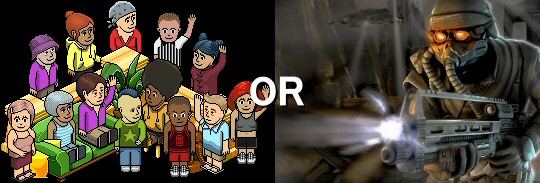
Now place your bets which is considered to be an image that represents ‘video games’ to a TV executive. It’s the angry, scary dude with a gun, obviously. Never mind the fact that happy clappy games like habbo hotel probably outsell the angry games with guns by a huge margin. Never mind the fact that gamers are actually interacting, often with other people, rather than passively absorbing the  predictable, mindless drivel of TV cooking programs and property shows. Never mind that the average gamer is no longer a 13 year old boy with poor exam results (Was that ever true?).

What’s more important is for gaming to be held up as something to be scared of. Why? Well here is the bitter, sad irony. Anyone in journalism worth their salt knows that fear SELLS. We are basically hardwired to be scared, to be hungry, and to want sex. Everything else is frankly an afterthought. Advertisers know this, and exploit it to death. Game designers are in kindergarten when it comes to manipulating their audience, take a look at adverts to see how it is really done.

And of course, taker a look at cheap journalism, of the ‘IMMIGRANTS CAUSE HOUSE PRICE FALLS‘ style, or more relevantly, the ‘GAMES ARE BAD’ sort we have got used to on TV.

Newspapers like the Daily Mail or News of the world vastly outsell stuff like new scientist, and it’s no surprise. We all know that a new scientist investigation into ‘does eating 5  a day make you healthy’ that concludes ‘it’s hard to say, it depends…’ won’t sell as well as a News of the world story that ‘FRUIT CAUSES AIDS!!!‘  What is really dissapointing is that the BBC doesn’t need to sell newspapers, or even subscriptions. It’s in the unique position of being able to say “This thing that we thought might be bad, turns out to be not bad”, and nobody would lose their job.

Pity they never do that, isn’t it?