Game Design, Programming and running a one-man games business…

Overcomplex mechanics can be a *good* idea.

Something I like in games, but see very little of, is over-complex mechanics. Some people will suggest that ‘it is by definition the case’ that over-complexity destroys fun and leads to a worse game. I would like to disagree.

To me, a good game is either trivially simple and thus a time-waster (nothing wrong with that per-se), a game of reflexes and agility (most FPS games), or a simulation so complex that the actual rules and mechanics become background noise. This is, I believe, one of the keys to the success of Democracy 3.
D3 models about 2,000 voters, each of which has varying memberships of 21 voter groups. Each voter group has inputs from maybe a dozen decisions (policy sliders and situations) and ANY one of those objects can have an impact on any other, with an equation that might be linear, quadratic or more complex than that. Plus there are variable starting conditions, mods and DLC.

Lets put it another way.

You CANNOT master Democracy 3. You just cannot. Not in a million years. Nobody adjusts a slider knowing the effect it will have, they make a guess. They have a hunch, they have a gut feeling, and they go with it. They *feel* their way through the game, they do not think it. This is good.

complex

A game that is complex, but not complex enough, can be ‘mastered’. You can work out how to ‘beat’ it, if you put the hours in. Assuming there is no fuzziness, it becomes merely a matter of solving a very very complex equation, which ultimately, all strategy games are. Once the equation is ‘solved’, all other strategies become moot, you have ‘beaten’ the game, and robbed it of any remaining fun.

When a game is so complex this is not an option, you do not strive for it. You aren’t trying to crunch the numbers and keep a model of the simulation in your head because this cannot be done. As a result you go with a more emotional, more touchy-feely approach to true strategy, instead of number crunching. I am a believer in the idea that all games are really about emotion, and if I am simply playing to work out what the numbers are, I’m doing maths homework, not feeling like a general, or a city-planner or an emperor or a politician.

I’m thinking about this now as I develop my next game design idea, and its in my head when I play other peoples games. I think designers have become far too scared of complexity, assuming that because there are lots of games, all games have to be casual, so as not to scare people off. We are getting less Grand Complex strategy and more games like cow-clicker. I don’t think its an improvement.

And I also think we can cope. Life itself is incredibly complex. We juggle so many millions of variables in our lives, but we don’t end up with decision paralysis or an inability to enjoy ourselves. We routinely shop at stores with 100+ types of biscuit, but we cope with the variety and the options. We can cope with it in games too. Give me more options, more mechanics, more systems, more biscuits.

biscuits

Less is not always more.


Battlefield 4 still *wins* at achievements

The battlefield 4 ‘meta’ game is a thing of beauty. You only really notice it when you start looking at Battlefront: Star Wars. I consider BF4 to be a standard I one day aspire to. Not in terms of the length of its grind to unlock, which is frankly nuts, but in terms of the wealth of stats, and the freedom you have in self defining your own metrics for success. Here is my Battlefield 4 main stats page.

bf4

There is SO Much stuff here, and every tab has additional data in excruciating detail   Its just awesome. What really makes it work for me are the multiple streams of data. I never care about my win/lose ration because I routinely swap sides to keep a game balanced (I hate one sided slugfests), but I can ignore that and focus on my unlocks, or my assignments, or awards, or maybe the leaderboards or kill/death ratio. It basically says ‘here is a whole bunch of cool stats, have fun with it all, and gives you a great gui and some shiny graphics to show off when you reach a milestone.

Basically, even the worst BF4 player in the universe has probably got a bunch of awards/icons/scores that they are proud of, and everyone’s style is different. This contrasts massively with the approach of far too many games which is “Game is done, throw in some achievements before launch and we are done.”

I’m as bad as the next guy. Democracy 3 has some pretty cool achievements (especially after the recent update), but thats all it has. There are not separate stats to measure stuff like the average crime rate over all your games, or per-country achievements or stats, or maybe the number of countries each situation has been achieved in, or your highest ever election victory…etc. There is a lot more scope for me to improve on stuff like that.

I’m working on my next game now (release date: errrr maybe next year?) and I’m already thinking I need to be aware of how cool this kind of thing is from a much earlier stage.

Where did the relaxed online worlds go?

When I was very very young, i remember reading some dead-tree magazine talking about online ‘chatrooms’ where people played a role playing game like dungeons and dragons. Its was probably a role-play chat room where people dialed in with their modems. It sounded amazing.

Imagine a whole alternate world where you could be a wizard! a space captain! a ferengi. A completely different existence free of the worries, stresses, concerns and hassles of the real world. Even as a kid I thought it sounded awesome. As I grew up, I found the idea even more appealing. Imagine a world with no boss, where you hang out in a space bar with aliens drinking weird space cocktails and talking about space stuff. No boss, no TPS reports, no income tax, just existing like a giant shared dream.

And then along came MMOs like everquest and killed my dreams.

Te way I imagined these online worlds were pure sandbox. No quests, no missions, no score, no rank, none of the status-chasing and accumulation targets of the modern world. I wanted an online bar. I wanted to be Quark, or morn…

morn

One day I thought I may even get my wish when they did a star trek MMO. it was AWFUL. They were so scared, so paranoid, so terrified that the attention-deficit generation wouldn’t love the game, that the VERY FIRST few minutes of the (hugely goal-driven game) involve an attack by multiple borg cubes. Talk about skipping to the end. This was existing in another life, another world, another place I could call home, this was just a multiplayer LAN style game full of people shouting at each other to join quests. Amazingly, considering it involved real people, the average modern day MMO is LESS human than a singleplayer game. In a singleplayer game there is some voice acting and some interaction with the player. An MMO is a series of bland NPC quest-vending machines stood repeating the same offer like a speak-your-weight machine crossed with spam email.
mess

The standard reaction to my kind of sadness about the state of MMOs is to point out that you have to play with people you know. To me, this misses the point. If there is a group of people I know, and can arrange to do something at the same time as me, I’ll go meet them for a drink or grab some food in the real world. The idea for me of an online existence is to meet new people, to chill out, to maybe explore the world a bit, but to feel no pressure. But this is impossible. I’m only Level 322 and everyone else is level 892, and the cool hats are only available at level 500+ unless you buy one on the market with 23,000 AddictionBucks.

The nearest thing we have to mazes full of human test subjects are MMO games. They are skinner boxes where not only are we all experimented on to extract more and more money from us, but we actually pay someone for the honor of being a test subject. I feel more ‘attacked’ and pressured in a F2P MMO or most MMOs than I do in the real world.

This is backwards.

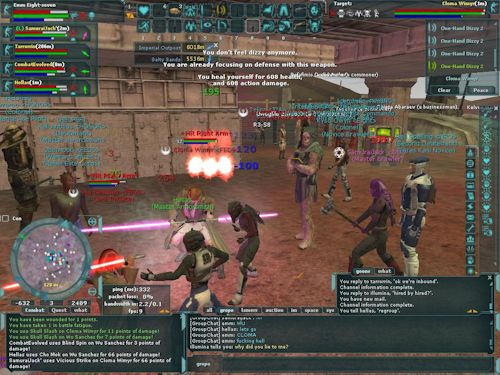
Star Wars Galaxies (when it first came out) was as close as I got to that Zen State. I was a wookie, I didn’t join clans or go on quests. I knew a few people playing but not many. I spent a lot of time on Tatooine crafting stuff, building up my little hovel with its moisture vaporators. It was fun. I’d go into town now and then to sell stuff, trade a little, see what was going on. It was kinda relaxing.

Where is the MO for relaxed people who don’t want to grind. Is there ANY MMO that doesn’t have scores/ranks/missions? Maybe just Second Life? Is it not really built yet, because game makers don’t realize a lot of us are 30 or 40+ and have jobs and want to chill-out, not get into another rat-race?

Musing on space battle tactics and improving the escort order

Sooo. In discussing this on my forums I thought it worthy of reprising here. Basically ships in GSB2 can have an ‘escort’ order which tells them to stay with X meters of another ship (user-configurable distance). This is all well and good, but you still want those ships to be useful in battle. Whether the ships are fighters/gunships or larger ships gives this order a different outcome. Here is an explanation of the current system…

The current system has non-fighter ships heading towards the point on the radius circumference of the escort order that represents the angle between the ship they are escorting, and their currently selected target enemy ship. (see below…)
ship_tactics1.png

On the other hand… fighters (& gunships), when given an escort order keep picking a random position within a half escort radius range of half way between the actual escort ship, and the target ship. (See below).

ship_tactics2.png

Now its actually very simple to make ships that are not fighters copy the fighter behavior if they have the KEEP MOVING order (which is implied with fighters & gunships). However, my question to you is…would that be desirable? I have essentially made a guess here when coding the game as to how people are thinking. I’m assuming that if you tell a frigate to escort a cruiser, you are saying ‘ by all means attack the enemy, head towards them, but don’t get more than X distance from your parent ship’.
An alternative meaning would be ‘always stay within X distance of the parent ship. If ordered to keep moving, do so, without any preference for location.

The current system leads to ‘frigate bunching’ at the nose of a cruiser or dreadnought. This means stationary ships in some cases, and susceptibility to area-of-effect weapons and detonation waves. But it does ensure escorting ships move into range when possible. Of course, if you really want to enforce some separation, we have the formation order… hmmmm.
Thoughts?

GSB2 Design mode composites (pre-built)

I admit it, it makes me cough and splutter a lot when people say ‘I don’t want to go to the trouble of designing the look of the spaceships, so I just slap down an empty hull graphic‘. It worries me because there are several downsides to this. Firstly, they are missing out a big part of the game, especially a big part of what makes GSB2 new. Secondly it means their challenges, screenshots and videos are going to give a poor impression of the game, because those naked hulls are…well naked, and simplistic looking. My engine can do better! Thirdly (and perhaps most importantly) it suggests that people think the ship design interface is too complex, or fiddly, or time consuming. This is something I’ve been working on.

Firstly we now have a lot of fixes that make composite objects work better, and rotation speeds are fixed, and there is now a handy ‘reset to zero’ button for rotation speed. Plus the interface now only shows color layer options when they are relevant, because always showing three confused people, as there are rarely three layers to adjust…

But something that was suggested, and it was a great idea, was that the game should come not only with all these tiny little widgets, but also some pre-built big components you can drag and drop to make the process quicker. I agree. This now acts as a half-measure between those people who couldn’t be bothered to design at all, and those who spend hours adjusting each fin.  Here is a screenshot of a naked hull surrounded by some of the pre-fabs you can choose from.

550

Those pre-fabs are ‘composite objects’ and you can just right click on one and split it into all its components. Each one has a big pile of them, and you can delete one, move one, and then regroup as a new composite if you like. You can scale and duplicate/mirror/set colors for composites just like anything else, it’s one of the ship editors best kept secrets.

On that topic, I should probably give some love and attention to nudging people into using the hotkeys on that screen, as frankly I never touch the size or angle slider for anything, its so much easier to use a mouse wheel with ctrl or shift. Here’s a closeup of a composite, made up of probably 30+ components.

composite

I’m going to spend some time today just making a few of these for each race. They act both as ‘quick-fixes’ to otherwise dull looking hulls, as well as a demonstration of the way composite objects work, which hopefully will nudge more people into creating their own. Eventually I’d like to see collections of them in the steam workshop or as lists of mods on the GSB2 website. I can foresee people getting reputations as expert ship designers!

If you just stumbled upon this post, this is a blog about the PC space strategy game ‘Gratuitous Space Battles 2‘ which is currently in beta, and you can pre-order the game and start playing right now by clicking this link here. Tell your friends!