Game Design, Programming and running a one-man games business…

Positech is funding a solar-powered borehole in cameroon!

Long time readers of this blog will know that in the past we have funded two schools being built in Cameroon through the charity ‘Building schools for Africa‘. To cut a long story sort, I wanted to do something charitable, that was efficient and effective, and frankly you get a real good ROI when you do something like this, rather than donate to a charity in a relatively rich country like my own. £15-20k spent on a UK school gets you not much, but it builds a whole school in Cameroon, so to me the choice is obvious. FWIW I have no connection to Cameroon, I’ve never been there, but its a poor country that could really do with some help.

I did actually do one local school thing here, We paid for solar panels to be put on the roof of a local primary school. If you are wondering what this solar obsession is all about, I started a solar-farm company and built one in the UK. Its a loooong story :D. Oh and we donated a bunch of money to War Child in the past too, which is a super worthy charity for refugees.

But anyway, we are doing it again! After a long gap in charity giving while I got stressed about the spiraling cost of the solar farm, I can finally do stuff like this again. I had contacted Building Schools For Africa a while ago saying if they have any more solar-powered borehole projects, I would love to fund one, and they recently got in touch with just that. They send you a big government study on the problems, the impact a borehole would have, a cost spreadsheet and feasibility report etc. In this case, I was sent the one for the school (which was paid for by another donor) at the location where they need a borehole and it made very depressing reading. The borehole will be in bagam, shown here:

If you read that report, you would NEVER complain about your school again. Its unlikely your school has insufficient textbooks, or a dirt floor that floods in the rainy season. Its unlikely that the roof leaks so badly that the (shared) schoolbooks get destroyed. Its very unlikely the lack of a door means stray animals wander in and do animal things in the classroom. And its super unlikely that all the kids arrive late, and tired because they have been sent miles before school to fetch water.

Luckily, a proper engineered borehole solves a lot of problems. Its mostly one of time. We take fresh, clean, drinkable water for granted, but we should not, because its not universal. If you have a long walk to fetch water every day, thats a huge economic impact. Less time to attend school, less time to work, and it has serious economic implications. Being able to access clean reliable drinking water right next to a school will be a fantastic thing!

The cost is about £20k. Here is some detail from the charity:

The project provides for a solar-powered pump, to take water from the borehole to a large storage tank and pipework to take it on to 3 stand taps at central locations in the community, as well as training in the maintenance of all aspects of the facility.  This project is expected to totally transform the community and allow it to thrive: it is also seen as a peace-building initiative in a part of Cameroon that has been struggling for the past ten years due to additional pressures caused by the anglophone crisis.

And from the feasibility report:

Due to the topography the environment and that of the school. We came up with the various considerations

The overhead storage tank can be constructed at the school where the borehole will be drilled. The water storage tank will have to be constructed high enough to overcome the steep nature of the environment to be able to supply water up to the market.

The borehole can be drilled at the market where it is higher than the surface of the school. The storage tank will be constructed just few meters above ground. With this height difference, with the help of gravity, water can easily flow down slope to the market, the priority consumers which is the school, the palace and nearby residents.

TBH I think ‘palace’ might be a mis-translation, as looking at the location, I do not see anything I would call a ‘palace’. Anyway, I am excited about the project, because I love solar power, and remote communities in Africa is EXACTLY the best use case for distributed solar generation. I’m definitely looking forward to seeing updates on the project. And of course solar powered means super-convenient, and no work for people collecting water. Plus I think its awesome that for a lot of those kids, they will start to associate electricity with solar power by default, which makes sense.

Anyway, this is my ‘feel-good’ project for the year!

Welcome to the new webserver!

This has taken a while. Much longer than I expected, and been difficult, but ultimately I think worthwhile. For a very very long time, positech’s website (and positech energy’s website) have been hosted in the USA. I think the server was in Dallas, Texas. But I’m not sure, nor did I care. The general assumption back in the 2000s was that most web traffic was from the USA, and to minimize page loading times, you should host your site in the USA, even if like me, you are personally in Europe.

But Lo! It came to pass that in 2025 and 2026 the USA got a new government that decided to treat my own country (the UK) like we are the enemy. I frankly got sick of reading comments from the likes of Trump and Musk that I lived under sharia law in a violent failed state. Especially given our gun crime rates are extremely low compared to the US, and that amazingly, the sharia law meme is total and utter made-up fantasy bullshit. Frankly, I got sick of being insulted by the leaders of a country I was regularly paying money to… and pretty much everyone I speak to here in the UK feels equally insulted and enraged.

I cannot change US foreign policy. I cannot change who the US public decided to vote in as their president (or effectively new King). But I do have choices as to how to spend my money, and given that its entirely up to me where I host my websites, I have decided to pick my own country (England!) as the best place. Frankly I do not *trust* any US web host any more. So I looked around and then found a web host called Krystal.

Krystal seem to have two selling points from my POV. One: They are in the UK (Woohoo!) and Two, all of their servers are one hundred percent powered by renewable energy. As anyone who has read my blog for a while will know, I like that! Granted, I am not exactly in desperate need to reduce my carbon emission, given that I built and own an entire solar power station, but if there are companies out there doing the ight thing regarding sourcing energy, I want to support them.

I have no idea where Krystal get their energy supply from, but in my fantasies, its coming from the wind farm right next to Trump’s scottish golf course.

I try to avoid being nakedly political on my blog. Thats not what its for but the ENTIRE reason for moving webhosts was to reduce my links in some small way, to the USA because of the current US govt, and I think it only fitting and fair to say so. The site currently has a bunch of DNS and domain name related problems, but I am sure they will get sorted out soon! Also I have some cool stuff to announce, once everything has finished moving and this blog is definitely working.

A calendar year of solar farm ownership

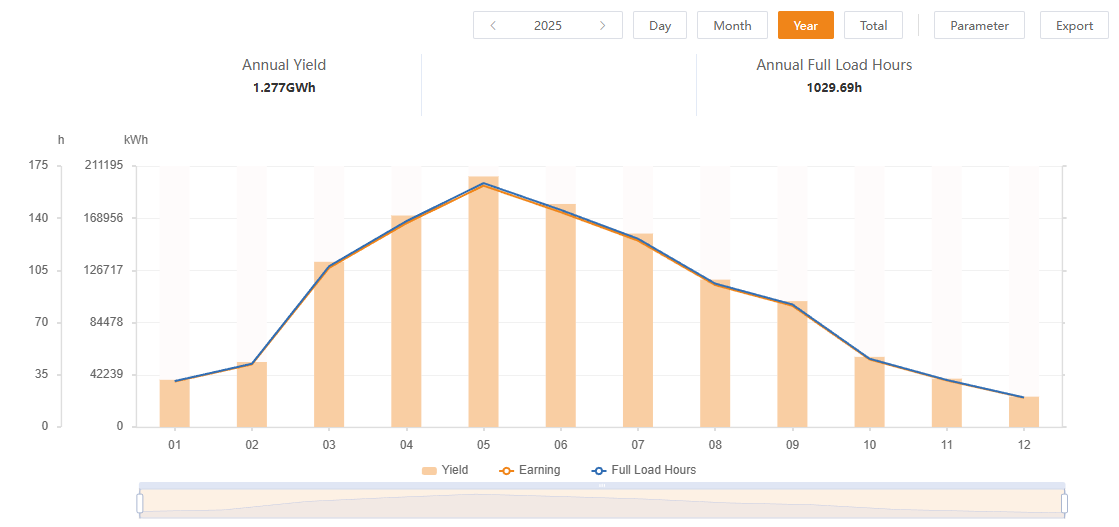
So yup, I somehow built a solar farm, and it was tricky, but now is the relatively easy bit, where I just have this huge capital asset sat on a hillside somewhere, and hopefully it makes some money? Lets look at what an actual real uninterrupted solar farm ownership year looks like. Which obviously means looking at the annual combined chart from the 10 Solis inverters:
I also have very similar data from the actual overpriced meter that measures the farm output. Thats normally lower (and is sadly the metric I get paid on), because there is some leakage of power in the transmission from inverter to to meter. However there was some data-outages in the inverter reporting during the year (since fixed with a better router), so some inverter data was lost, but caught by the Orsis meter, which is therefore a higher number! Here is that chart:
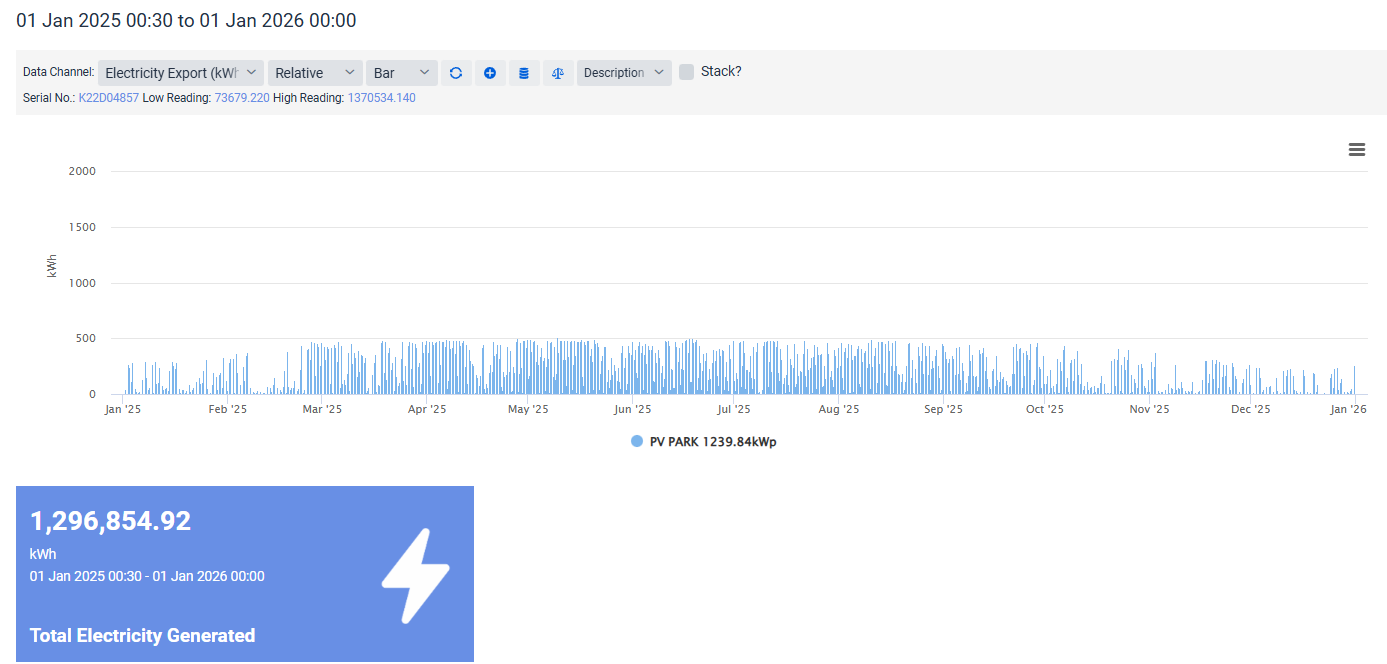
So in general the chart of output was pretty much as expected, as was the total output. There was a bit of a weird skew towards earlier in the year. March and April were weirdly high, and July and August weirdly low. Normally I would expect a perfect bell curve. BTW if you have home rooftop solar and think this chart looks weirdly smooth, be aware that we have obviously no shading, and the panels cover 4 acres, so any minor fluctuations do tend to cancel each other out. But anyway, lets talk business!

I do not have actual accounts for that period, but a quick rough check shows that the money paid to me in that 12 months by the energy company I sell to (Ovo) totalled about £146,000. That includes selling the REGO certificates, also to Ovo. That sounds quite nice until you deduct all the costs. So for example:

  • Energy import costs (to run the site) £6,000
  • Rent payment to landowner £6,200
  • Internet/Connectivity for meter £800
  • Accountancy for company £1,000
  • Repair costs for storm damage £8,000
  • Other minor costs £100
  • Maintenance (Annual) £9,300

So some quick sums show a whopping annual profit of £114,600. OMG amazeballs.

But hold on a minute… surely I need to depreciate a solar farm that has cost me about £1.6m to build. So over 25 years that becomes an annual depreciation of £64,000. so that leaves me with a profit of £50,600.

I would be very happy with that, but in truthy I need to set aside funds for two other events. One would be the failure of an inverter. They are not cheap, and replacement costs are non trivial, so lets assume this costs me £10k every year. Lets also assume there is some money set aside for some catastrophic event requiring panel replacements, or theft of cables etc, and put that at another £15k a year (minimum). Thats then a profit of £25,600 per year.

Also be aware that the output from the panels will very slowly degrade over time, so the revenue may actually fall, and if wholesale energy prices fell, they could fall further. But lets be optimistic and go with £25k a year in actual profit. That works out at a return on investment of about 1.56% a year. Now to be fair, everything needs to be inflation adjusted, as prices will rise, but so will costs, and therefore that 1.56% is a REAL return, not the same as interest on a bank account. So for example, right now my company bank account pays 4.25% but inflation is 3.5% so the ACTUAL rate of return is only 0.75% which means…

THIS GIVES ME A BETTER RETURN THAN A SAVINGS ACCOUNT

Which is a relief (that its not actually losing money), but still a little less than hoped for, But if you know me, you know I did this for the environment, and to do my bit in the fight against climate change, even if certain maniacs in the US are determined to actually do the opposite and kill us all. This was never a business decision, but a passion-project one. And who knows, energy prices could rise! And in terms of ‘the solar business’ I did a VERY BAD JOB of getting this built. That £1.6m could have been more like £1.3m if I was more aware of what I was doing. I am very sure that big solar farm developers, or just more experienced ones do a better job, have economies of scale, and get better returns.

I regret nothing. I won a solar farm and its awesome. I didn’t do a good job of getting it built, but I made it happen!